The Dining Table Edit
Round vs Rectangular Dining Tables
The right shape is not decided by fashion. It is decided by the room, the circulation around it and the way people gather in your home.
A dining table is rarely just a place to eat. It becomes the centre of family life: breakfast before school, work spread across one end, dinners that run late and celebrations that ask for one more chair.
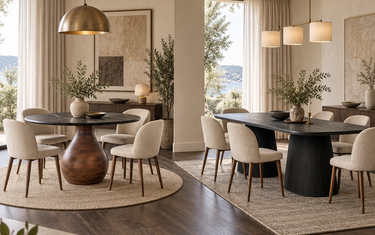
Round and rectangular tables create very different rooms. A round table encourages conversation and softens a compact space. A rectangular table gives structure, seats more people efficiently and suits the proportions of most dining rooms. Before choosing, measure the room and leave approximately 900mm between the table edge and nearby walls or furniture wherever possible.
Choose round when…
The room is square or compact, conversation matters, you prefer softer lines, or you want flexible chair placement without corner legs.
Choose rectangular when…
The room is long, you regularly seat six or more, you want a strong visual anchor, or the table needs to divide an open-plan space.
The case for a round dining table
With no corners and no head of the table, a round design feels naturally sociable. Everyone faces towards the centre, passing plates is easier, and the curved edge leaves circulation feeling more fluid. This is especially useful in an open-plan kitchen or a dining area crossed several times a day.
A pedestal base strengthens the advantage. Without four legs occupying the perimeter, chairs can move around the table more freely and an occasional extra seat is easier to accommodate.

Round table in focus
Orb Marble Dining Table — 120cm
Real black marble sits above a sculptural mango-wood pedestal. At 120cm across, it seats four comfortably while the central base keeps the entire perimeter clear for chairs.
View the Orb Table →
Natural character
Montpellier Reclaimed Elm Table
For a softer country or collected interior, reclaimed elm brings visible grain, variation and a sense of history. Its 1200mm round format gives that character without visually crowding the room.
Explore MontpellierThe case for a rectangular dining table
Most dining rooms are longer than they are wide, which is why a rectangular table so often feels immediately correct. It follows the architecture, makes efficient use of wall length and creates an obvious place for chairs along both sides.
For larger families and frequent entertainers, length is the decisive advantage. A 2000–2200mm table gives guests more elbow room and offers enough surface for serving dishes, flowers and the things that make a dinner feel generous.

Contemporary statement
Contour Ribbed Dining Table
A 2000mm black table with strong architectural presence. Its ribbed bases turn a practical rectangular format into the focal point of a modern dining room.
View Contour →
Made for generous rooms
Winslow Pillar-Leg Dining Table
At 2200mm long, Winslow has the scale for family gatherings and entertaining. Substantial pillar legs give it the calm, grounded quality of a permanent centrepiece.
View Winslow →A simple decision guide
| Consideration | Round | Rectangular |
|---|---|---|
| Best room shape | Square or compact | Long or open-plan |
| Conversation | Naturally inclusive | Better for larger groups |
| Circulation | Soft, corner-free movement | Efficient along straight walls |
| Visual effect | Softens the room | Defines and anchors it |
★★★★★
Don't take our word for it
Read what Online8 customers say about product quality, honest advice and furniture delivered across New Zealand.
Read Our Google ReviewsThe last word
Choose the shape that respects the room before the one that looks best in isolation. Bring your measurements to our Papatoetoe showroom, or call our team on 09 278 8881. We can help you compare sizes, seating and the clearance your room needs.
Find the table your room has been waiting for
Explore dining tables online with nationwide delivery, or visit Online8 at 29 Charles Street, Papatoetoe, Monday–Saturday, 10am–4pm.
Shop Dining Tables Shop Dining Chairs